 Title: Catch-22
Author: Joseph Heller
Published: 1961 Pages: 463
Genre: Literature
Rating: 4.5/5
When I finished City of Thieves, I thought it would be fun for Scott to pick out my next book for me. YES this made me incredibly nervous, especially since I was afraid he'd pick a long book just to spite me. I guess I shouldn't have been too surprised that he picked Catch-22, and despite every excuse I could think up to read it, I buckled down and had my go. It wasn't an easy go, and I really don't know how to write about this book, so I'm going to use the same type of format as I did for my Middlemarch review. It'll be a long post, but the headers will hopefully help you skim. :)
Summary
Can we just skip this part? Please?? Fine. Catch-22 is about a group of pilots stationed in Italy during World War II. At the beginning of the novel, the men are close to flying all of their assigned missions, but the colonels keep raising the number of missions they must fly until it seems they will never be able to come back home alive. Much of the book is about the main character, Yossarian, and his struggle to cope with the constantly rising number of missions he must fly.
There is a wide cast of colorful characters (more on that later), and while the book is very much about the war, there isn't actually a whole lot about the war in the story. Instead Catch-22 is about the soldiers' experiences and thoughts, their day to day routines, the games they play (mental games), and when words begin to fail me--just plain shenanigans. The book is almost more a collection of anecdotes than a straightforward story with a simple plot. I suppose the best way to describe Catch-22 is to provide Heller's own definition:
"There was only one catch and that was Catch-22, which specified that a concern for one's own safety in the face of dangers that were real and immediate was the process of a rational mind. Orr was crazy and could be grounded. All he had to do was ask; and as soon as he did, he would no longer be crazy and would have to fly more missions. Orr would be crazy to fly more missions and sane if he didn't, but if he was sane he had to fly them. If he flew them he was crazy and didn't have to; but if he didn't want to he was sane and had to; but if he didn't want to he was sane and had to. Yossarian was moved very deeply by the absolute simplicity of this clause of Catch-22 and let out a respectful whistle. 'That's some catch, that Catch-22,' he observed" (47).
What I likedThis book is a perfect example of why I love reading so much--it challenged me, made me think, made me cry, made me laugh, made me grab my pencil to underline passages, makes me want to start re-reading it again right now. I'll be very honest--I didn't get everything in this book and it would take at least another reading for me to fully appreciate it. But while the book was a bit of work, it didn't feel like work. The writing is surprisingly easy to digest, even though the logic is often circular as seen in the quote above, and sometimes felt like listening to a child who keeps asking "why" to every retort (or in other words, a little obnoxious).
But just when I would get the hang of the sarcasm and senselessness of the story, Heller would throw in a beautiful passage that would just make my heart want to break. A perfect example of this is in the last quarter of the book when Yossarian is roaming the streets of Rome after a pilot had been killed in flight--Chapter 39, The Eternal City. The writing in this chapter is incredibly absorbing and emotional and just plain superb. But then at the end of the chapter, one of the soldiers kills a woman and just when Yossarian thinks the police are coming to arrest the other man, they arrest him for being in Rome without a pass and you want to scream, "You've got to be kidding me!" Really, though, I can't adequately explain why I love this book. I feel like I use the word "rich" a lot in my reviews, but when the shoe fits...
What I struggled withFor the entire first quarter of the book I had no idea what was going on. The story obviously wasn't linear but I couldn't quite figure out what was going on. Each chapter focuses on a certain character, but I couldn't keep them straight, couldn't figure out the timeline of events, didn't know if the book was supposed to be funny or just absurd. Going into the book I knew it was a war book, but I kind of thought it was set during Vietnam (impossible given the publication date), but I don't remember any explanation of where the characters were or what they were doing. While by the end of the book I still didn't have a strong grasp on the timeline or just exactly what had happened when and to who, I decided it wasn't the point of the book for me to know and understand all of this. Afterall, war doesn't make sense. The logic isn't always perfect and more times than not it's faulty or subjective. And to me, the way this book is written shows that very well.
The Characters
Oh my gosh. Too many characters. Like I said, each chapter focuses on a different character, and while I got to know some of them, the rest kind of blurred together for me. Milo is one of my favorites--he is the mess officer and sets up different trade routes all throughout Europe and at times has a direct affect on the market as well as certain battles during the war. The Chaplain was another of my favorites, and I think Heller used his character well to show the internal struggles of the war and also how one deals with the insensitivity all around him. Major Major Major just makes me laugh. And then Colonel Korn and Colonel Scheisskopf. And then of course the heart and soul of the story, Yossarian. I want to tell you more, I want to tell you all of the stories, but the delight in this book is experiencing it all for yourself.
Miscellaneous
I guess I don't have much to add here. This review is long enough. But let me throw out a question. Were you assigned to read this? For what class and why do you think this was assigned reading? This is the type of book that I would have loved to read for class and be able to dissect all the little parts. It's the type of book that we could come up with several different answers to the question of what this book is about.
In the end?So glad I didn't let myself talk myself out of reading this one. It's been sitting on the shelf for years and probably would have stayed there for years longer if Scott hadn't picked it out. I was just saying a few months ago how I didn't have a strong desire to read this book. I know several people who have given up on it halfway through, and I can understand why. But in the end, I was incredibly satisfied. No, I didn't get it all, which is why the demoted rating, but sometimes we don't need to get it all. Please don't let my "I didn't get it" statements intimidate you and discourage you from reading this book. It is highly readable, but I think it takes a little bit of patience not to shoo away that pestering child when there isn't always an answer for the question "why."
Officially my longest review. Does that alone tell you how I felt? :)

**For a balance of opinions (let me know if I missed yours):
Bibliofreak (JT Oldfield)
Books 'N Border Collies (Lezlie)
The Hidden Side of the Leaf (Dewey)
It's All About Me (Joanna)


 Happy Sunday! Well, I'm back to talking books this week. As I was entering some of my new purchases into my Excel spreadsheet, I thought I'd share with you how I catalog by books.


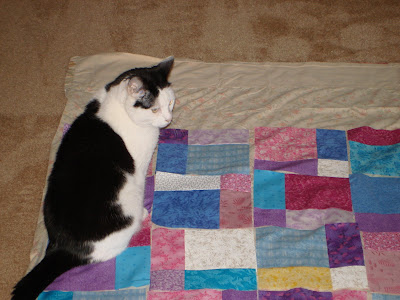

 Isn't he cute?


 is about a young man, Lev, who is trying to make his way on his own in Leningrad during the Nazis' siege during World War II. Most of his family has fled the city or has already been claimed victim to the war, but he remains in the desolate city with a group of other misfits. One night he happens upon a dead German parachuter and while looting the soldier's pockets, he is arrested. In prison, he meets and befriends Koyla who has been imprisoned for deserting the army. Lev and Koyla are given another chance at freedom by an army colonel if they complete a dangerous mission for him--finding a dozen eggs for his daughter's wedding.


 As I mentioned above, I have a weird thing about talking animals, but I love how Spiegelman chose to portray the different races in the book--mice for Jews, cats for Germans, pigs for Poles, so and and so on. I don't know for sure what Spiegelman's intentions were with these depictions, but on the one hand I saw the stereotypical cat chasing mouse theme, but on the other--and more importantly, it showed the ridiculousness of distinguishing between different races. I don't think I'm making sense with that thought, but it's there in my head.


