Showing posts with label Holocaust. Show all posts

Monday, October 26, 2009

The Boy in the Striped Pyjamas - John Boyne

Title: The Boy in the Striped Pyjamas
Author: John Boyne
Published: 2006 Pages: 216
Genre: YA Fiction
Rating: 3/5

My poor brother has been asking me to read this book for months now (he's thirteen). I'm always reluctant to borrow books from people because I know my turnaround will never be as quick as if I loan out a book. There's so many I've obligated myself to read for challenges or for authors/publishers, not to mention the giant shelf of TBR books. I promised him I'd read BSP for the readathon and I'm so glad I did. When I texted him that I had finished the book he texted me back "it's about time." Yup, it sure is.

The Boy in the Striped Pyjamas begins with nine year old Bruno and his family who live in a nice big five story home in Berlin. Bruno's father is a very important person, though, and has been asked by the Fury (Hitler) to take post at a strange camp in a far away place called Out-With (Auschwitz). Bruno is upset because the house is much smaller and his sister Gretel (a Hopeless Case) refuses to play with him. As Bruno begins to explore the new home, he discovers that there is a giant camp across the yard with lots of men and boys all wearing the same striped pyjamas. In his exploration, he meets a boy sitting by the fence of the camp whom Bruno befriends.

What I loved about The Boy in the Striped Pyjamas is the simplicity and innocence. Bruno doesn't understand why his parents have moved, he doesn't understand the camp beyond his home's yard, and he doesn't understand why his friend can't come across the fence to play or why Bruno can't go to the other side of the fence. There is something so sweet about Bruno's innocence and refusal to judge those who are a little different from him. I also have a tough time believing, though, that the son of a Commandant who is overseeing one of the largest concentration camps in the world doesn't know what a Jew is and whether he is a Jew or not. That aside, Bruno's innocence came across as genuine.

"What exactly was the difference? [Bruno] wondered to himself. And who decided which people wore the striped pajamas and which people wore uniforms" (100).

This is a short book that can be read within a couple of hours, and while I do recommend it, it isn't as powerful as some of the other books I've read about the Holocaust or World War II. Could this partly be because it was written for young adults? I don't know--I've read some pretty powerful young adult books (The Book Thief is one I highly recommend). I guess the unbelievablity of the story continued to tug away at me. I was shocked by the ending of the book, and even though it's not hard to guess this book would not have a happy ending, it left my heart hollow.

Have you read this book or seen the movie? How did you feel about it?


Join Cym Lowell's Book Review Party Wednesday!

Tuesday, July 7, 2009

The Complete Maus - Art Spiegelman

The Complete MausTitle: The Complete Maus
Author: Art Spiegelman
Published: 1986/1991 Pages: 295
Genre: Graphic Novel/Memoir
Rating: 5/5

This is the type of book that I hate writing about—the one that I loved so much that I simply can’t do it justice or organize my thoughts in a coherent manor. So, here we go:

Go read it. The End.

Ok, I guess I’ll go into a little more detail. I’ll be honest, I was pretty resistant towards this book. I had some prejudices that were holding me back a little bit. What prejudices? Well, mostly the talking animals. I know, it’s weird, but talking animals are sometimes a turn-off for me. It almost seemed childish that the author would choose to portray the Holocaust using mice and cats and Jews and Nazis—part of me even though this was a children’s literature book. But I’m glad I finally read enough reviews to convince me to get this book. I waited patiently until my 40% coupon for Borders arrived so I could rush off and buy a shiny new hardcover edition—the complete edition.

The Complete Maus is a combination of biography and memoir—the story Art Spiegelman’s father's survival of the Holocaust, particularly his imprisonment in Auschwitz, and Spiegelman's own experiences with his father as he works on the book. I loved both parts of the book equally, but the dynamics between Arty and his father, Vladek, created such an intimate texture to the story. I can't say I particularly cared for either Arty or Vladek as characters--Spiegelman often shows them with all their faults in plain view--but the creation of Maus gives the two common ground and helps each other understand one another better.

Spiegelman's father's story provides the meat of the book. It begins during Vladek's youth and his increasing success in both his personal and business life. He marries into a wealthy family of Polish Jews and quickly rises in his various occupations. This all quickly halts, however, when the Nazis begin imposing laws and regulations aimed at denigrating the Jews. Vladek and his wife, Anja, are successful in keeping from imprisonment for a long time due to Vladek's industrious nature and the strong ties they have to wealthy Jews, but eventually they are forced to enter Auschwitz along with hundreds of thousands other Jews.

Like any other book about the Holocaust, Maus is incredibly heartwrenching and oftentimes unbelievable. I was constantly angered and sicked by the crimes committed and the atrocities millions had to endure. What makes this book especially poignant is its illustrated form. I can't imagine a more effective way for Spiegelman to share his father's experiences. I'm constantly amazed at what authors can accomplish in the illustrated form--the emotions the drawings can portray, the multi-layered dimensions of the story, the action, the misery, the joy, the love. There is a lot to be said about words, and I am a lover of words, but the drawings in this book continually speak for themselves--conveying things that words simply cannot accomplish.

illustration from The Complete MausAs I mentioned above, I have a weird thing about talking animals, but I love how Spiegelman chose to portray the different races in the book--mice for Jews, cats for Germans, pigs for Poles, so and and so on. I don't know for sure what Spiegelman's intentions were with these depictions, but on the one hand I saw the stereotypical cat chasing mouse theme, but on the other--and more importantly, it showed the ridiculousness of distinguishing between different races. I don't think I'm making sense with that thought, but it's there in my head.

This review is already far longer than I wanted it to be and I still feel like I haven't said anything at all. We've all read Holocaust stories before. We know the history and we know what happens. But this is different than anything I've ever encountered before and I can't recommend it enough. I couldn't be more glad that I put my prejudices aside and read this book. Although I'm haunted by what I read and saw in this book (what was I thinking children's lit??), I am grateful that Spiegelman was persistent enough to get his poor stubborn father's story to share with us all. It is not one that should be overlooked or forgotten. None of them are.

So what do you say? Are you going to read it? If you have read it, what did you think?

Tuesday, October 21, 2008

Anne Frank: The Diary of a Young Girl (and Giveaway!!)

Title: Anne Frank: The Diary of a Young Girl
Author: Anne Frank
Date Finished: Oct 18, 2008 #60
Pages: 258
Published: 1947

This probably was not the best book to pick for the read-a-thon, but since reading Anne Frank Remembered several months ago I've been looking for a good time to revisit this one (it's been about 15 years since I read it last). I loved getting to know Anne again, but her story is so heartbreaking. Just as I was coming to the end of the book, with about 15 pages left, I started thinking about how it would probably be best if I put the book in the freezer and pick something else up for the read-a-thon. And then I flipped the page. And the book was over. There was nothing left except the Afterward. And that was enough to leave me a sobbing heap on the couch as I cried for the hope that Anne felt, her hope that was never realized.

For those who might not know, Anne and her family, who were Jewish, went into hiding in Amsterdam in 1942. Her father, Otto Frank, and his coworkers devised a plan for him and another family to live in the secret annex of his work office. For two years, eight people lived in the cramped quarters of the second and third floor of the building. Anne, who was 13 when her family went into hiding, kept a journal (which she named Kitty) about the daily happenings in the Annex for the two years they lived there.

There are several things that surprised me about Anne. First, she has become so immortalized and idolized that I think we forget that she was a just little girl (whew...going to try and make it through this without balling my eyes out). While Anne was incredibly brave, she was hardly perfect. At times she was love sick, others she fought with her parents (and really did not like her mother). She didn't want to stay cooped up in the Annex and at times she was a little bit of a pest. And all of these things, all of Anne's imperfections, make me love her all the more:

"In spite of all justice and thankfulness, you can't crush feelings. Cycling, dancing, whistling, looking out into the world, feeling young, to know that I'm free--that's what I long for; still, I mustn't show it, because I think if all eight of us began to pity ourselves, or went about with discontented faces, where would it lead us? Sometimes I ask myself, 'Would anyone, either Jew or non-Jew, understand this about me, that I am simply a young girl badly in need of some rollicking fun?' I don't know, and I couldn't talk about it to anyone, because then I know I should cry. Crying can bring such relief" (111).

Another thing that surprised me was how mundane some of the entries were. This goes back to the idea that Anne is a real girl, not an idealistic caricature. And while some of her entries were simply what the dinner conversation was that night or what their weekly menu was or how she was tired of Mr. Dussel, she also talks about her dreams and desires--some immediate and some for the future. She is a hopeful girl who is full of life. But the book was not written as a memoir in hindsight of the events--what she writes about is immediate. To me this makes her story a little more untainted than some of the other accounts might be (I hate to say that any of the others might be colored--but she was writing about what she knew/felt when she knew/felt those things).

Anne Frank's diary is incredibly touching. Not only is it a look into the lives of the eight in hiding, but it is also the look at how the hiding and war affected a teenaged girl who on one hand grew up entirely too fast but on the other never really got to grow up at all. If you haven't read it, I would highly recommend it. The book isn't terribly long, and while it isn't necessarily "light" reading it is insightful and beautiful.

GIVEAWAY!!

Several months ago I read Anne Frank Remembered by Miep Gies. I was surprised at how many people had not heard of this wonderful book. I have an extra, gently used copy that I would love to pass on to you. To be entered to win Anne Frank Remembered, please leave a comment below letting me know you're interested. To be entered TWICE, also leave a comment on the original post (please make it more substantial than "hi"). To be entered THREE times, blog about the giveaway. Don't forget to tell me about it! Because I feel that this is a very special story that needs to be shared, the giveaway is open to everyone (but be sure I can easily get ahold of you).

I'll draw a name on Thursday October 30 at 6:30 am central time.

*If you want to be entered and have already commented on the original post, you don't need to do so again. ;)

Thursday, May 29, 2008

Anne Frank Remembered - Miep Gies

Title: Anne Frank Remembered
Author: Miep Gies
Date Finished: May 29, 2008
Yearly Count: 28
Pages: 252

It has been so long since I have read Anne Frank: The Diary of a Young Girl that I could only remember a few of the details. I don't even actually remember reading it (I think I must have been in 7th grade), but many of us are familiar with Anne's story of her life in hiding for two years.

While this book suggests a remembrance to Anne, it is more specifically Miep's own story of courage and survival as she helped the Franks into hiding in German-occupied Holland during World War II. While working for Otto Frank in the early 1930s, Miep also became his confidant as life became more and more difficult for the Jewish population in Amsterdam. Eventually, Frank asked Miep and her husband Henk to help hide his family and eventually another family (altogether eight people) in the cramped upper level living quarters of Frank's business.

Over the course of more than two years, Miep and her husband Henk provided sustenance, safety, and above all friendship to the families they kept in hiding. As I was reading this book, I was struck by Miep's undying compassion and courage to do unthinkable things--putting her life at risk to helps those around her whose lives were also in such grave danger. I simply cannot fathom the things that these people had to live through. Things that people are currently living through. This book broke my heart, but at the same time the strength of all of those who resisted the cruelties of the Nazis showed such hope for mankind.

Miep's writing style is effortless and flowing; she has the natural voice of a storyteller, which made this book absorbing. My grandmother has a beautiful accent (she is Swiss but also studied in France and England before moving to Toronto after the war--so her accent is a little mixed), and I could hear her voice through Miep's writing. Soft but at the same time urgent:

"As I sat, I became aware of what it meant to be imprisoned in these small rooms. As this feeling registered, I felt a taste of the helpless fear that these people filled with, day and night. Yes, for all of us it was wartime, but Henk and I had the freedom to come and go as we pleased, to stay in or go out. These people were in a prison, a prison with locks inside the doors" (128).

My only regret about this book is in the ending. It seems as though Miep isn't quite sure how to end such an important story and so the last few pages are a little forced and awkward. Otherwise, this was such a powerful and important read. There are only little bits and pieces about Anne in the book, so it really makes me want to re-read Anne's diary. In addition to this book, I'd also recommend The Hiding Place by Corrie Ten Boom--also a woman who helped in the Dutch Underground during WWII.

Saturday, January 19, 2008

The Book Thief - Markus Zusak

Title: The Book Thief
Author: Markus Zusak
Date Finished: Jan 19,2008
Yearly Count: 4
Pages: 550
Rating: 5/5

I've been putting off this post for a while because I'm not quite sure how to approach this book. So many have read it and reviewed it, but for whatever reason I haven't been able to get ahold of my thoughts. But...times a tickin' so its time to get on with it.

The Book Thief is the story of a young girl, Liesel, in Nazi Germany told through Death’s narration. Yes, Death personified. Death becomes interested in Liesel’s story when he comes to pick up her brother after he dies; Death, against his better judgment, goes to the funeral and sees little Liesel picking up a book from the snow—her first act of book thievery. Shortly after Liesel’s brother dies, her mother moves her to a foster home on Himmel Street where her world is quickly turned upside down. Her world and everyone else’s. (While I don’t think I can possibly cut this short, I will not give spoilers).

Liesel’s new living situation is not easy. Her new Mama is slightly abusive and walks all over her and her new Papa. Papa, though, takes Liesel under his wing as he comforts her during her nightmares and teaches her to read her stolen book. Liesel also finds sanctuary when chumming around with her new friend Rudy as well as in the mayor’s wife’s library where she retreats after she delivers and picks up the laundry for Mama.

But everything changes when one day a strange man shows up at the house looking for Liesel’s Papa. Max is a Jew. He has left his family, gone into hiding, and is barely surviving. Papa has made a promise to help Max, so it is agreed that Max can live in the basement. At first Liesel is a little frightened of Max, but soon they grow to be good friends—especially when Liesel realizes that Max also has nightmares. But, keeping a Jew in the basement is dangerous. Just as giving bread to Jews as they march to the concentration camp, as Papa does, is dangerous. Everything in Nazi Germany has its consequences.

After reading stellar reviews about this book in the blogosphere for the past six months, I was finally able to get my hands on a copy. I devoured the 550 pages in a few short days (don’t let the label of YA fool you—this is a rich novel). While sometimes I flew through the chapters, there were others where I was so overcome by emotion that every word took effort to absorb. But what I found so fitting in this novel, so perfect, was that it is about words. The power of words and what we are with them—and without them. How words can bring an unlikely person into power and consequently change the world as we know it.

This is a beautiful book and it will stick with me for a long time. I loved Death’s narration; his style is effortlessly engaging—sometimes witty, sometimes unbearably true. And while I’m not quite sure what I will do with what I took away from this book, I will continue to pass this book on to others. I hope you’ll read it, too.

Tuesday, June 12, 2007

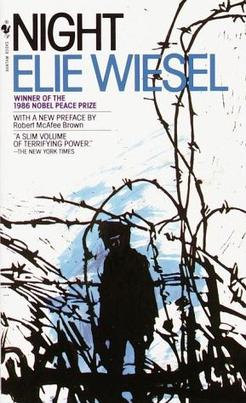
Review: Night - Elie Wiesel

*Image from papercuts.tscpl.org
Title: Night
Author: Elie Wiesel
Date Read: January 2007
Rating: 4.25/5

I'm not sure what happened between the years that I was in high school and when my sisters went, but I wasn't assigned this book. So, like usual, I took my sisters' handmedown for this one (pretty sure they probably haven't read any of those books I "borrowed").

What a powerful little book. I read Night in a few hours (although maybe stretched over two days...?). Wiesel's memoir begins in a sleepy town in Transylvania--seemingly far away from the dangers of the Nazi's. It comes to pass however, that the SS does invade the town and Wiesel's family is sent first to Auschwitz where he is separated from his mother and sisters, but sticks by his father's side. The rest of the novel recounts the horrid details of the Holocaust and Wiesel's own fight to survive. The details he
offers are sobering--it is a tough look into humanity at its worst.

While the book in many ways is important for our understanding of the things that happened, things that are too horrible for me sometimes to even comprehend (I would also recommend "The Hiding Place" by Corrie ten Boom and Primo Levi's accounts for different perspectives), don't expect to feel uplifted at the end of the novel.

"I wanted to see myself in the mirror hanging on the opposite wall. I had not seen myself since the ghetto. From the depths of the mirror, a corpse gazed back at me. The Look in his eyes, as they stared into mine, has never left me" (109).