Showing posts with label By the Decades. Show all posts

Monday, February 11, 2008

I won I won I won!!!

I was just notified by 3M at 1 More Chapter that I won the grand prize in her By the Decades Challenge. For this challenge I read 13 books (decades 1880-2000). I really struggled with this challenge because by the end of the year I was burned out and didn't want to read the books I selected. This was one of the first challenges I joined, and I was a little over-ambitious in my selections. But, I pushed through, used one alternate, and finished the challenge. Yay!!!

Thanks, Michelle for the great challenge and the prize! I am so excited and can't wait to browse Amazon for my book choice. YEEEEEEEEEEEEEEEEEEEEE!!! Like a kid in the candy store (or more likely a bookaholic in a bookstore).

*I have selected Half of a Yellow Sun, which is fitting because it is a book I discovered through the blogosphere. Yippee!

Thursday, January 3, 2008

2007 Challenges

2007 Challenge Review

Blogging brought a whole new element to my reading--challenges. What I really like about challenges is the themes, which in a way reminds me of grad classes--like little mini classes that I don't have to write papers for. Also, challenges helped me with getting some of those OLD TBR books off the shelf as well as helping me determine what books to read next. On the other hand, though, I didn't leave myself enough room for whimsical choices, so I often felt burned out with books I had picked months in advance.

Non-Fiction Five Challenge (5 books)

Nickel and Dimed - Barbara Ehrenreich (Economics)

His Excellency: George Washington - Joseph J. Ellis (Biography)

The City of Falling Angels - John Berendt (Travelogue)

What I really liked about the Non-Fiction Five Challenge was that it nudged me into reading a genre I normally wouldn't touch unless assigned for school (and even then...?). The toughest book to slog through was definitely His Excellency; I honestly can't choose one that I liked the most--and not because I loved them all. Oh well!

By the Decades Challenge (13 books)


What I really liked about this challenge is that I was able to read pieces of fiction from a timespan of about 115 years. The differences between the earlier pieces to the later pieces is remarkable, really highlighting how the novel has developed. My favorites would have to be Fall On Your Knees and The Blind Assassin; my least favorites were Dinner at the Homesick Restaurant and Howards End.


RIP Challenge (12 short stories)


I've been wanting to read this collection for a while, but I ended up really struggling with getting it read! My favorite stories were "Pit and Pendulum" and "Tell-Tale Heart"; there were several other stories (e.g. The Gold-Bug) that didn't strike my particular fancy.

Something About Me Challenge (5 books)

Pride and Prejudice - Jane Austen

Like Water for Chocolate - Laura Esquirel

High Fidelity - Nick Hornby

Sea Glass - Anita Shreve

The Thirteenth Tale - Diane Setterfield

This was a fun challenge because it was so different and the books I chose were from a pool of selections from other bloggers. The only book on this list I didn't really like was Like Water for Chocolate. All the rest were books that I enjoyed a lot--The Thirteenth Tale and High Fidelity being two of my favorite reads for the year.

Classics Challenge (3 books)

Frankenstein - Mary Shelley

The Scarlet Pimpernel - Baroness Emmuska Orczy

Little Women - Louisa May Alcott

Once I started paying more attention to my reading habits, I was surprised at how many classics I read throughout the year. This challenge was easy to fulfill and I liked Frankenstein and The Scarlet Pimpernel a lot; Little Women did not live up to my re-reading expectations.

Armchair Traveler Challenge (6 books)

Travels with Charley - John Steinbeck (America)


The Things They Carried - Tim O'Brien (Vietnam)

Eat, Pray, Love - Elizabeth Gilbert (Italy, India, Indonesia)

The City of Falling Angels - John Berendt (Venice)


One of the goals I have is to really reach outside of my boundary comfort zone. Most of the authors that I read are North American or British and while the locales differ from story to story, I haven't exposed myself a lot to writers from different countries. While I didn't do this except for maybe Snow, this challenge certainly raised my awareness. A Thousand Splendid Suns was my favorite of the bunch; Snow was my least favorite.

2nds Read Challenge (3 books)

Thirteen Moons - Charles Frazier

Flesh and Blood - Michael Cunningham

Northanger Abbey - Jane Austen

Overall I enjoyed my second helping of these three authors, but none of them were as good as the first I read by the authors (Cold Mountain, The Hours, and Pride and Prejudice). But all three authors I would devour for a third helping!

Total Challenges: 7 (one challenge not listed: 07-08 Book Awards Reading Challenge)

Total Challenge Books: 35 (one cross-posted in two 2007 challenges)
New Authors: 22

Friday, December 21, 2007

Johnny Tremain - Esther Forbes: A Novel


Title: Johnny Tremain
Author: Ester Forbes
Date Finished: December 21, 2007
Pages: 256
Rating: 3.5/5

This is my desperate move to finish the Decades Challenge since I obviously was not going to finish All The King's Men (and probably never will--urg!). It could also qualify for the Book Awards Challenge since it won the Newbery quite some time ago, but I still have a few months to finish that one. Ohh, challenges challenges.

Johnny Tremain is the story of a fourteen year-0ld silversmith apprentice in pre-revolutionary New England. He is bossy and proud, but also very talented; one day, though, he disfigures his hand after another apprentice purposely gives him faulty equipment. He cannot craft silver anymore, but he finds another job as a rider for the Boston Observer. During this time he meets many of the key revolutionary figures in Boston, including Paul Revere, John Hancock, and Samuel Adams; Johnny is key in keeping these figures abreast of the revolutionary situation in Boston--especially as the fighting begins.

I liked this book, but I didn't think it was anything spectacular. I would recommend it--as I tried doing to my 11 year-old brother--but the plot isn't very exciting. I think perhaps its just the style of writing because of the history of what was happening at the time is very exciting. Easy and light--a story of forbidden love, fighting for what one believes in, discovering one's heritage, and growing into the responsibilities of adulthood.

Sunday, November 25, 2007

The World According to Garp - John Irving: A Review

Title: The World According to Garp
Author: John Irving
Date Finished: November 25, 2007
Pages: 437
Rating: 4.25/5

Not really quite sure how to summarize this one. Or explain my feelings. I read this one for the Decades and Book Awards Challenges and put it off, put it off, put it off. I did like this book--a lot, but I didn't really know what to expect because I had heard so much praise for it. The best way that I can describe it is that it is like Tom Robbins but less blatantly metaphorical and less shocking. Although there is a lot of shock value in this book.

And sex. In fact it had a lot of the same sexual themes as Flesh and Blood (minus AIDS) although Irving is in many ways a little more subtle in his terminology and descriptions than Cunningham. The book begins with Jenny, a nurse taking care of patients during the war--particularly a Technical Sergeant Garp whom she has sex with in order to conceive a child (because she doesn't want to get married or have a baby the "conventional" way). The book is about her son, Garp, from the time he is a baby until...well...his whole life. :) The book discusses the intricacies of his marriage and affairs, his relationship with his children, the heartaches and joys of his life.

I really liked this book--but it was tedious at times. Garp is a writer in the novel, which is a major part of the plot. Little snippets of his works are included within the book but I found myself getting bogged down in these stories. They didn't take up a great length of the book, but I found them distracting and poorly written (which I guess maybe they were supposed to be?). Another thing that I found distracting was the narrator; the narrator is omniscient and mostly just a narrator, but sometimes he made his presence a little too noticeable. I'm not sure how to explain this except that the narration sometimes felt contrived. Not like the narrator of The Unbearable Lightness of Being who I thought was entertaining and endearing. Overall a good book and won't be my last Irving--but maybe I'll read a little Robbins first.

Tuesday, November 6, 2007

The Age of Innocence - Edith Wharton: A Review

Title: The Age of Innocence
Author: Edith Wharton
Date Finished: October 29, 2007
Pages: 286
Rating: 3.5/5

I chose to read this book because a) its been sitting on my shelf for years and b) for the Decades and Book Awards challenges. There were some parts of the plot that I really liked, but mostly it was enjoyable reading about the social obligations of New York's uppercrust in the late 1800s. But overall, I was a little disappointed in the actual story. Blah!

The story follows Newland Archer who is engaged to May, a beautiful and naive young woman; both Newland and May are members of New York's upper class where strict social protocol dictates much of their lives. Everything is going well for Newland and May and their engagement, but the arrival of Ellen, May's intriguing cousin who is recently separated from her European husband, shakes up Newland's emotions. Ellen is everything that May is not--particularly "free"--and Newland finds himself falling for her. The remainder of the story deals with whether Newland will settle for a safe and predictable life with May or leave her to be with Ellen.

There were a few parts of the book that I found really confusing--it seemed as though Wharton was more subtle in discussing some of the scandals that occurred in the book and because the social conventions of the 1870s are lost on me I didn't always quite follow what was going on. This was a pitfall of the book for me. What I missed I was able to supplement with secondary reading, but too much was lost in "translation". I would recommend the book for a study of social conventions, but that is really the only part of this book that truly appealed to me.

Sunday, October 7, 2007

As I Lay Dying - William Faulkner: A Review

Title: As I Lay Dying
Author: William Faulkner
Date Finished: October 6, 2007
Pages: 261
Rating: 3.5/5

I chose this book both for the Book Awards Challenge and By the Decades Challenge (1930s), but I have been putting it off for months. I have a bitter-sweet relationship with Faulkner. I am fascinated by him, and in many respects he is one of my favorite American authors (at least non-contemp), but nothing about his writing is straight-forward. Frankly, sometimes his writing is exhausting, which usually tires and bores me, but with Faulkner its almost as if I know he is playing some joke on me and I won't be made the fool. Anyone reading this who is not a bibliophile is probably thinking, "Cuckoo!" :)

As I Lay Dying is the story of The Bundren family: Anse, Addie, Cash, Darl, Jewel, Dewey Dell, and Vardaman. Addie, the matriarch, is dying, and Cash, the eldest son, is building her casket while she watches. Once Addie dies, the Bundrens make an arduous journey to Jefferson to bury her-a journey which is the key of the story. What I love about Faulkner is his experimentation with point of view; I was first captivated with this years ago when I read The Sound and the Fury. Had I continued with my graduate studies, I probably would have focused on narratology. Throughout As I Lay Dying each character helps narrate the story giving his/her unique perspective on the events--which is why the reading can be so exhausting because the reader constantly has to be the judge of what is really going on and which narrators can be trusted. And Faulkner doesn't give anything to his reader for free. The reader must work for it (and I did my fair share of secondary reading while working through this book).

Did I like the book? Yes and no. I liked most of it, but it was difficult and sometimes I just need a no-brainer. But I love a good reading challenge. In terms of content? Faulkner is always depressing. I'm not sure if I have ever really liked any of his characters. He loves to show the dark and sinister, which I also like, but come on guy--can't you give just one character a break?? See what I mean when I say bitter-sweet?

Sunday, September 30, 2007

Howards End - E.M. Forster: A Review

Title: Howards End
Author: E.M. Forster
Date Finished: Sept 30, 2007
Pages: 236
Rating: 1.5/5

I read this book for the Decades challenge (1910) and every single minute of it was pure struggle. OK, not every minute, but mostly every minute. This book is only 236 pages, but it took me two weeks to finish!!

The story is about Margaret Schlegel who befriends her neighbor Mrs. Wilcox. When Mrs. Wilcox passes away, she leaves her home, Howards End, to Margaret--although Margaret is unaware of the bequest. After the death, Margaret then befriends Mr. Wilcox. A strange type of courting pursues and they eventually become engaged. On the sidelines of the story are Wilcox's extravagant and snotty children and Margaret's aloof sister Helen. In the side-sidelines are the Basts, Leonard and Jacky, who are of a lower class but become entwined in the story. Its difficult to give a summary without giving away any of the plot, so that's basically it. Most of the story is wrapped up in class issues, the Mr. Wilcox and Margaret's courtship, and family scandals.

I've recently heard good things about Forster, particularly his A Passage to India but this is quite possibly the worst book I have read all year. Granted, I did just start a new job on Monday, but I was struggling even before my time got cut in half. And I'm not even really sure why I disliked this book so much! The character development wasn't half bad, but I found the writing a little confusing and very anticlimactic. The last couple of chapters were the best in the book, but I thought the writing was boring and without passion. I would not recommend this book and if you are reading it or plan to, I hope you have much better luck than I did. :(

Saturday, June 30, 2007

Heart of Darkness - Joseph Conrad: A Review

Title: Heart of Darkness
Author: Joseph Conrad
Pages: 96
Date Finished: June 30, 2007
Rating: 4.5/5

Don't let the number of pages fool you, this book is packed full--every word brimming with meaning. I don't pretend to fully understand this book, and I think that after reading it again (and again and again) I will still be able to pick up something I hadn't the first time around.

The tale begins with Marlow telling his fellow shipmates of his journey on the Congo River into well...the heart of darkness. Although this is a story about his journey, it is also a look into humankind, especially as Marlow is in search of the white trader, Kurtz, who seems to have crossed the line between civilization and savagery.

"They howled and leaped, and spun, and made horrid faces; but what thrilled you was just the thought of their humanity--like yours--the thought of your remote kinship with this wild and passionate uproar" (44).

Recommendation: I can't possibly do this book the justice it deserves. I would recommend this book to everyone. But, be prepared to pay attention. I can usually knock out 96 pages in a day, but I took three days to read this book, and still I wonder if I blew through it too quickly. The prose is so rich and beautiful, but also haunting. As Kurtz cries, "The horror, the horror." I will be revisiting this one again.

Monday, June 18, 2007

Review: The Portrait of a Lady - Henry James

Title: The Portrait of a Lady
Author: Henry James
Date Finished: June 18, 2007
Pages: 578
Rating: 3.25/5


After just finishing this book, I'm still not sure how to react to it. I read this as part of the Classics Reading Group, but also included it in the By the Decades challenge (for 1880s). Many hail this book as one of James's finest, but since I've only read a handful of his short stories, I can't really judge on that.

The story is about a young woman, Isabel Archer, who travels from her native America to Europe after her father dies. She claims to be an independent woman and takes every measure to prove herself to be just that. The book asks questions about how independent can a woman at this time truly be and at what does it cost to be independent (I'm not referring to monetary costs, although that subject also arises in the book).

For me the book was a little tragic--for the costs of Isabel's independence seem rather great. If you've read my review for Dinner at the Homesick Diner you know that I like to have complete little redemptive endings, and once again I did not find this here.

Recommendation: Not for the light reader. James relies heavily on character development in this book, and often times my eyes would begin to glaze over at the lengthy descriptions that often lasted pages. I guess one literally gets a great "portrait" of all of the characters once the book is through. The dialogue was enjoyable, and I grew to appreciate the descriptions, but it took a lot of patience and a lot of time to get through this one. I'm glad that its over and I can put it back on the shelf.

*picture courtesy www.bookcourt.org

Review: The Awakening by Kate Chopin


Title: The Awakening
Author: Kate Chopin
Date Finished: June 17, 2007
Pages: 190
Rating: 3/5

I chose to read this book because it fulfilled my 1890s decade for the By the Decades reading challenge. Well, and it had been sitting on my shelf for quite some time. Finally, I've read a few of Chopin's short stories and really enjoyed them.

This book, however, lacked much of the color that can be found in her shorter fiction. Edna, the main character, becomes bored and restless in her marriage and decides to break convention and live her own life. Much of this occurs after meeting Robert, so it is difficult to discern whether she had always been unhappy or if the emotions were sparked by the more "free" people around her.

The book follows Edna's desires and yearnings, but the question is how independent can a woman during that time period actually be? Will she be happy? I hate to ruin an ending, so I won't.

Recommendation: The book is short and very easy to read. As you can see by my rating, I thought the book just OK. I think that Chopin's short stories show much more passion and life. The Awakening seemed a little dull to me.

Tuesday, June 12, 2007

Review: Fall On Your Knees - Ann-Marie MacDonald


Title: Fall On Your Knees
Author: Ann-Marie MacDonald
Date Read: May 31, 2007
Rating: 4.5/5

I picked this book up several years ago at the Plano Book Sale, and I'm not sure why I let it sit on my shelf for so many years, but it did (along with all my other TBRs). In May I joined a few book clubs on Yahoo, and this was the selection for Bookworms Reading Group. I joined too late to join in any of the discussion, but I was glad it gave me the push I needed to read this book. Who knows how long it would have sat along side all the other poor TBRs before I finally went for it.

Fall On Your Knees is the story of the Piper family. The beginning of the novel gives the reader snapshots (almost literally) of the Piper family mentioning that they are all dead now. What a beginning! James Piper falls in love with the younger Materia Mahmoud; they fall in love, elope, and she is disowned by her Lebanese father. The book follows three generations of Pipers, unraveling the secrets of their sordid pasts. Because of the complex nature of the novel, it is difficult for me to write this review and not give away any details. So, perhaps I'll just outline some of the themes.

Themes prevalent throughout the novel: The novel deals with an number of themes including religion (specifically catholic), teenage prostitution, miscegenation, alcoholism, child abuse--wow, what a downer. Despite the very heavy themes of the novel, MacDonald has a way of showing the love the family possesses and the redemption that can be claimed as the novel comes full circle at the end.

Recommendation: Hmm, I'm not sure who I would recommend this book to. It's not light reading, and the themes are rather depressing, but I thought it was very well-written. MacDonald plays around with perspective as she constantly (and almost fluidly) switches from third person to first person with all of the characters. She also gives pieces to the puzzle throughout the novel in different forms such as diary entries, articles, letters, and even sometimes poetry. If you're looking for something different, try this one out.

Review: The Blind Assassin by Margaret Atwood

Title: The Blind Assassin
Author: Margaret Atwood
Date Read: April 24, 2007
Rating: 4.75/5

The Blind Assassin is my second Atwood novel (other is The Handmaid's Tale), and after a second helping, I will certainly be holding my plate out for more, and more, and more.

Most of the novel centers around Iris Chase as she recalls the events of her past (she is an older woman at the time of her recollection). Intertwined into Iris's memoirs is also the posthumously published "The Blind Assassin" novel written by her sister Laura Chase who died in a mysterious car accident. While the story within a story motif was a little difficult to handle at first (science fiction meets literature noir), I found myself wrapped up in the story as the novel progresses. On a third level is newspaper clippings of pertinent events in the lives of the Chase family. All three parts work together a beautiful, yet sad, story.

The book itself was a little difficult for me to start, but once I was sucked into the story of the Chase girls (Laura and Iris)--well, I guess I've already said it--I was sucked in. Atwood's writing is beautiful as she tells a story of loss, submission, secrecy, and denial. The plot twists and turns as the reader tries to make the connections between the Chase girls through Iris's account, the newspaper articles, and the nameless characters of the posthumous novel.

Recommendation: I would recommend this book to people who like a mystery a little out of the ordinary (although Atwood gives enough clues throughout the text to make the ending a little predictable--but still enjoyable). Certainly a book for Atwood fans. Not for the beach book reader, but I think its a book that can be enjoyed by a large number of different readers.

Review: One Hundred Years of Solitude - Gabriel Garcia Marquez


Title: One Hundred Years of Solitude
Author: Gabriel Garcia Marquez
Date Read: May 2007
Rating: 3.5/5

I would have to say that this was my first attempt at "literary" reading after graduating in December--now after reading this book I feel fearless again. If not for Booksamonth book club, I probably would have left this one sitting on the shelf just a little bit longer.

The book follows seven generations of the Buenedia family in a mythical South Ameircan town (much of the events are based on Colombian history). The book chronicles the rise and fall of Maconda--through revolutions, invasions, love affairs, incest, modernization, colonialism, and much more. Garcia Marquez uses magical realism throughout the novel--a device used by many South American authors (Isabel Allende's The House of Spirits comes to mind). While some readers get a little annoyed by this device, I felt it brought a sort of charm to the novel. For example, one of the characters simply floats off into the air and is never seen again.

Recommendation: This book is definitely for the patient reader. I would recommend going to wikipedia and printing off the family tree and keeping it very very close while reading. Many of the characters share the same names, which can become confusing--especially through seven generations. I gave this book a 3.5 rating with a little hesitation, but mostly because of the accessibility of the novel (or lack thereof). The story itself was enjoyable, but it took some work.

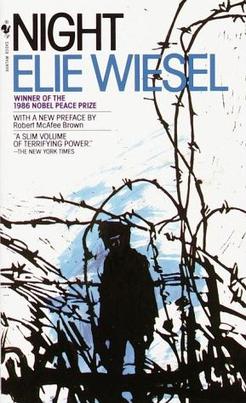
Review: Night - Elie Wiesel

*Image from papercuts.tscpl.org
Title: Night
Author: Elie Wiesel
Date Read: January 2007
Rating: 4.25/5

I'm not sure what happened between the years that I was in high school and when my sisters went, but I wasn't assigned this book. So, like usual, I took my sisters' handmedown for this one (pretty sure they probably haven't read any of those books I "borrowed").

What a powerful little book. I read Night in a few hours (although maybe stretched over two days...?). Wiesel's memoir begins in a sleepy town in Transylvania--seemingly far away from the dangers of the Nazi's. It comes to pass however, that the SS does invade the town and Wiesel's family is sent first to Auschwitz where he is separated from his mother and sisters, but sticks by his father's side. The rest of the novel recounts the horrid details of the Holocaust and Wiesel's own fight to survive. The details he
offers are sobering--it is a tough look into humanity at its worst.

While the book in many ways is important for our understanding of the things that happened, things that are too horrible for me sometimes to even comprehend (I would also recommend "The Hiding Place" by Corrie ten Boom and Primo Levi's accounts for different perspectives), don't expect to feel uplifted at the end of the novel.

"I wanted to see myself in the mirror hanging on the opposite wall. I had not seen myself since the ghetto. From the depths of the mirror, a corpse gazed back at me. The Look in his eyes, as they stared into mine, has never left me" (109).

By the Decade Reading Challenge

January 1-December 31, 2007

Well, apparently I am a sucker for challenges, since this is my second one in two weeks. Like the Book Awards Reading Challenge, 3M is hosting the By the Decade Challenge. Although the challenge started in January, I've been able to list some of the books I've already read this year taking care of the later part of the 20th century. Some of the books I'm able to cross link with the BARC--and the best news is that except for the 70s decade I own all the books. Yeah! I love productivity.

Here is my preliminary list. I've stopped at the 1880s, but I may try to squeeze in a few more since I'll be reading Vanity Fair (1840s) next month for Bookworm Reading Group. Note to self--stop trying to be overzealous!

1880 – The Portrait of a Lady by Henry James (1881)
1890 – The Awakening by Kate Chopin (1899)
1900 – Heart of Darkness by Joseph Conrad (1902)
1910 – Howard’s End by E.M. Forster (1910)
1920 – The Age of Innocence by Edith Wharton (1920)
1930 – As I Lay Dying by William Faulkner (1930)
1940 – All the King’s Men by Robert Penn Warren (1946)
1950 – Night by Elie Wiesel (1958)
1960 – One Hundred Years of Solitude by Gabriel Garcia Marquez (1967)
1970 – The World According to Garp by John Irving (1978)
1980 – Dinner at the Homesick Restaurant by Anne Tyler (1982)
1990 – Fall on your Knees by Ann-Marie MacDonald (1996)
2000 – The Blind Assassin by Margaret Atwood (2000)

Hmm, I wonder what other troubles I can get into...

Friday, June 8, 2007

Review: Dinner at the Homesick Restaurant - Anne Tyler

Title: Dinner at the Homesick Restaurant
Author: Anne Tyler
Date read: June 4, 2007
Rating: 2.5/5


What can I say about this book that so many others seem to love? Well, there are books about dysfunctional families that have some sort of redemptive ending, and then there are books that are just about dysfunctional families. This book falls into the latter category for me.

I read this book for my Booksamonth reading group on yahoo and had heard such great things about the book. I wanted to like it, I really really did.

But I didn't. The book is about Pearl Tull and her children Cody, Ezra, and Jenny. Pearl's husband leaves one day for a business trip and doesn't come back (Cody, the eldest is 14). The remainder of the book tells the story of their lives from that point forward. One of the more qualititive parts of the novel is that it switches between the points of view of the different characters. So, not only does the reader get to see Pearl's opinion, but we also get to experience the events through Cody, Ezra, and Jenny--all three children shed a very different light on their lives.

Perspective aside, I found the book incredibly depressing and I couldn't believe the ending. While part of the event at the end (no spoilers) was expected, I was very disappointed in how the characters reacted. I wanted a book about a family who grew stronger after a horrible incident, but the book is more about four separate and distinct individuals who act as individuals instead of parts to a whole.

Recommendations: While the book was very easy and fast to read, I'm at a loss of who I would recommend the book to. Sorry for all of you Anne Tyler fans. This is my first Anne Tyler book, and probably my last.