Showing posts with label "W" Author. Show all posts

Sunday, November 8, 2009

Ethan Frome - Edith Wharton

Title: Ethan Frome
Author: Edith Wharton
Published: 1911 Pages: 181
Genre: Literary Fiction/Classic
Rating: 4.25/5

Set in the early twentieth century in a remote and wintry part of Massachusetts, Ethan Frome is a tragic and heartbreaking story of love and betrayal. At the beginning of Ethan Frome, the unnamed narrator encounters Frome and other townspeople who know Frome and the narrator pieces together the events described in the book. Frome, a quiet man, lives with his sickly wife, Zeena, who is several years his senior. Zeena's cousin, Mattie, also lives with them and she is young and beautiful. Ethan takes quite a liking to Mattie and while Zeena leaves town to seek treatment for her ailment a quiet affair between Ethan and Mattie ensues.

Even though I hosted the Classics Challenge, I have been terrible at reading classics lately. This is the first I've read in months and reading it made me want to toss everything else aside and seek refuge in classics for the rest of the year. Wharton's writing is spellbinding. The story is a simple one and even the writing is fairly simple, but the heartache is palatable in the book. Ethan is such a complicated character torn by his emotions for Mattie and his duty to Zeena. Even though this is such a short book, Wharton's descriptions are so impactful. The sexual tension between Mattie and Ethan is on the one hand subtle and hardly existent, but the richness with which Wharton describes Ethan and Mattie's encounters tore at my heart:

"The sudden heat of his tone made her colour mount again, not with a rush, but gradually, delicately, like the reflection of a thought stealing slowly across her heart. She sat silent, her hands clasped on her work, and it seemed to him that a warm current flowed toward him along the strip of stuff that still lay unrolled between them. Cautiously he slid his hand palm-downward along the table till his finger-times touched the end of the stuff. A faint vibration of her lashes seemed to show that she was aware of his gesture; and that it had sent a counter-current back to her; and she let her hands lie motionless on the other end of the strip" (95).

The above comes from a fairly long passage and I wish I could include it all, but I don't want to give too much of the event away. But even as almost nothing happens in this passage there is still an electricity that can be felt through Wharton's description. Love it. The only other book I've read by Wharton is The Age of Innocence and I don't remember it having quite the same passion (all I remember really is that the ending ticked me off).

If you're looking for a short and engaging classic, I would recommend Ethan Frome. I read this within a few hours, and because I read it for the readathon I'm sure I missed much of the depth, but it is one that I would love to go back to one day. And it certainly makes me eager to read more of Ms. Wharton's works. Any classic that has me wanting more is definitely a good one in my book!

One more thing but since this contains spoilers, don't read on if you haven't read the book. When I closed the covers for Ethan Frome I was struck by how messy the book ended. It seems nowadays that everything needs to be wrapped up in a neat little bow, but I loved how tragically unhappy this book is. Doesn't that sound strange! It almost killed me when Ethan and Mattie drove for that tree in order to be together, but for all three of them to end up in the same household together is almost unbearable. I'm not really sure what to make of any of this--I guess just an observation--but it isn't often that such powerful endings are found in modern literature? Of course they're there, but maybe just not as often? Ramble over.

What was a classic you've read that had you reaching for more?

Hope everyone's having a good week so far!


**Edith Wharton is actually going to be on tour in January via the Classics Circuit! Be sure to check out the fun!

Thursday, October 22, 2009

Fingersmith - Sarah Waters

Title: Fingersmith
Author: Sarah Waters
Published: 2002 Pages: 582
Genre: Literary Fiction
Rating: 4.25/5

Fingersmith begins with a poor orphan, Susan Trinder, who has been taken under the wing of a band of thieves after her mother was hung for murder when she was an infant. When Susan is around seventeen years of age, her adoptive mother Mrs. Sucksby agrees to let her partake in plot to deceive an unsuspecting and rather innocent woman out of her inheritance. Gentleman, the head of the plot will woo and marry Maud Lilly, who is also orphaned and lives a sheltered life with her uncle, and then commit her into an asylum while Susan and Gentleman make off with a small fortune.

I finished this book over a week ago and have since been trying to formulate my thoughts in a coherent fashion. While I really liked this book a lot I keep wanting to focus on some of my more negative feelings. I think those feelings come, though, from knowing too much about the book before going into it. Everyone has raved about this book--calling it the best plot ever devised and twists and turns that will cause your head to spin. Yes, both of those things carry weight, but knowing that going into the book caused me to anticipate too much and so for the final third of the book I felt a little let down. This is why I don't read plot summaries--the less I know about a book going into my reading, the better the outcome for me.

All that said, let's get on to the good bits. I loved the atmosphere Waters created in this book. It is foggy and gritty and seedy and every bit the Victorian London Dickens would have written. There are pickpockets and colorful characters. Mrs. Sucksby is quite the lady (rolls eyes) and Gentleman--well, don't let the name fool you. My favorite characters, though, are Susan and Maud. In many ways the two are perfect companion characters, each highlighting the characteristics of the other in their many differences. The book switches between the two girls' perspectives and so the reader gets a clear look into the motives and emotions of each. I love perspective and point of view and Waters did an amazing job creating a distinct voice for Susan and Maud.

And then there is the writing. For me Waters' writing snuck up on me--in many ways it is simple and nothing to shout about, but the way that she turns a phrase is quite beautiful. She writes with passion and breathes life into her characters. I don't need a lot of dialogue in the books that I read, mostly because I feel like dialogue is often forced, but Waters hits the language of the characters dead on. Their conversations are realistic and she uses this as well as the characters' inner thoughts to show what is going on--she lets her characters develop the book rather than laying it all out by herself. Does this make sense? Some authors just tell you, but Waters shows. It makes sense to me. :P

But an example--taken from the second half of the book narrated by Maud:

"I think she must see it [desire]. Now he has named it, I think it must colour me--I think it must mark me crimson, like paint marks the hot red points, the lips and gashes and bare whipped limbs, of my uncle's portraits. I am afraid, that night, to undress before her. I am afraid to lie at her side. I am afraid to sleep. I am afraid I will dream of her. I am afraid that in dreaming, I will turn and touch her..." (293).
I love the parallelisms in her writing, but more than that the passion. And let me tell you this book is passionate! Nymeth gave this book the Most Beautiful Sex Scene Award and I'm going to have to agree with her completely. Oh my goodness. Prudes don't fear--there is nothing terribly graphic about this book nor the sex scenes. There is a bit of language, but it's sparse and not overly offensive. And more than anything, this book is the epitome of a page turner. Even at 582 pages long this book is a fairly quick read and a rollercoaster of a ride.

One more bit that made me chuckle then be grateful of times changed:

"Fancies, Mrs. Rivers. If you might only hear yourself! Terrible plots? Laughing villains? Stolen fortunes and girls made out to be mad? The stuff of lurid fiction! We have a name for your disease. We call it a hyper-aesthetic one. You have been encouraged to over-indulge yourself in literature; and have inflamed your organs of fancy." "Inflamed?" [Maud] said. "Over-indulge? Literature?" "You have read too many books" (447).
Ok, I guess that ended up much better than I thought it would. I do really recommend this book. Besides--everyone else is reading it, why shouldn't you? Even a week and a half after finishing I'm still mulling over the events and characters of this book!


Thursday, April 9, 2009

The Glass Castle - Jeannette Walls

Title: The Glass Castle
Author: Jeannette Walls
Date Finished: April 8, 2009 #17
Published: 2005 Pages: 288
Rating: 5/5

I know you're eyeing that 5 out of 5, but let me tell you--it has been a long time since I've read a book that so completely consumed me. Often, even if I'm really liking a book, I'll get a little bored halfway through, but with this one I could not put it down and kept turning page after page all the way until the end. What a great surprise given the mixed reviews I've seen for this book.

The Glass Castle is Jeannette Walls's memoir of growing up in extreme poverty, and sometimes even extreme neglect, with parents who clearly loved her and her siblings, but did not know how to provide for the family. Jeannette is the middle child, with an older sister, Lori, younger brother, Brian, and a baby sister, Maureen. Jeannette and her siblings became fighters and survivors as their parents dragged them from hovel to hovel--sometimes living in dilapidated shacks, sometimes living with relatives, sometimes just squatting wherever they could find shelter. They were always doing the "skeedadle" to escape the law or debt or to try and find work--first through small desert towns in the west and eventually in West Virginia.

Walls tells her story with biting and bitter humor, but there is also such tenderness and hope in her voice as she tries to understand why her father refuses to find work (he is convinced he has been blackballed by the unions) or why her mother puts up with her drunken father who gambles and drinks away their little money or why her mother chooses to lounge about when she has a valid teaching certificate and can get a job at the drop of a hat. Everything to her parents is an adventure, and I had to sometimes laugh with sadness when Jeannette's mother was so backwardly positive about everything and how her father was always able to convince the kids that he never let them down.

The book is sad and heartbreaking, there is no doubt. And there were things that made me want to scream and throw the book at the wall. I spent a great deal of the book being incredibly angry at Jeannette's parents and their actions (or lack of action). What kept me compelled to keep reading, though, was knowing that Jeannette and her siblings made it out of the hole their parents dug for them and that they succeeded despite everything that was thrown in their way. Jeannette never lost faith and continued to persevere even when it seemed that everything had been taken from her and her sisters and brother.

I wish I could find a short passage from the book to show Walls's writing style, but her paragraphs flow so beautifully that it was difficult to find a self-contained passage. In the passage below, Jeannette's father keeps throwing her into a hot spring before she knows how to swim; the second passage is when Jeannette is a teenager trying to grapple with her mother's wild mood swings.


I staggered out of the water and sat on the calcified rocks, my chest heaving. Dad came out of the water, too, and tried to hug me, but I wouldn't have anything to do with him, or with Mom, who'd been floating on her back as if nothing were happening, or with Brian and Lori, who gathered around and were congratulating me. Dad kept telling me that he loved me, that he never would have let me drown, but you can't cling to the side your whole life, that one lesson every parent needs to teach a child is 'If you don't want to sink, you better figure out how to swim.' What other reason, he asked, would possibly make him do this?
Once I got my breath back, I figured he must be right. There was no other way to explain it (66).

****************************************************************

It was hard for me to believe that this woman with her head under the blankets, feeling sorry for herself and boohooing like a five-year-old, was my mother. Mom was thirty-eight, not young but not old, either. In twenty-five years, I told myself, I'd be as old as she was now. I had no idea what my life would be like then, but as I gathered up my schoolbooks and walked out the door, I swore to myself that it would never be like Mom's, that I would not be crying my eyes out in an unheated shack in some godforsaken holler (208).


I would highly recommend this book. Yes, there have been a lot of mixed reviews. Yes, the subject matter is tough to swallow. Yes, it might seem a little inconceivable that Walls can remember so vividly to when she was three years old or that all of these things could truly happen to one family (some people think this--this is not necessarily my thought). But despite everything else, this book has so much emotion and heart and I think you'll find yourself cheering for Jeannette all the way until the end. If you're looking for a good non-fiction book for the NFF challenge (hint hint), this would be perfect.

These people read it too:
(If I'm missing yours, please let me know--the search results went crazy with this one)

Thursday, November 6, 2008

The Swiss Family Robinson - Jan Wyss

Title: The Swiss Family Robinson
Author: Jan Wyss
Date Finished: Nov 5, 2008 #64
Published: 1812 Pages: 304
Rating: 2/5

Talk about books that have been sitting on your shelf for years! I’m not even sure how long this puppy has been decorating the shelf (collecting dust is more like it), but I think maybe I got this from my Grandma years and years ago. To be honest, I haven’t really had much of a desire to read it, but I was tired of looking at it!

The Swiss Family Robinson is about a husband, wife, and their four boys who are shipwrecked and deserted on an island in the East Indies. The rest of the crew is able to sail away to safety in the lifeboats, but the family is left behind on the boat so they must make their way to the island in order to survive. They learn the terrain and the flora and fauna and eventually make various homes on the island.

I started off liking this book much more than I expected. I disliked Robinson Crusoe (perhaps because I HAD to read it for a grad course) and I expected this one to be similar. But I was surprised at how easy the reading was and how engaging the characters were. There was a lot of dialogue, especially between the father and his sons, which was nice since Crusoe didn’t have much dialogue except with Polly (the parrot) until Friday came along. But, then I realized that this isn’t an adventure book like I thought it was going to be.

The Swiss Family Robinson is more of a didactic book about survival in the wilderness. The father is constantly creating lessons out of every daily aspect and is often condescending to his children. He chides them for not having knowledge, but the knowledge the father possesses is completely from books he has read (how convenient!). After getting further into the book, I had to change my perspective and read this book for the interesting things the family built and how they survived in the wilderness instead of for a wild adventure. The book is an interesting look at the nature of animals as those in the early nineteenth century understood them (before Darwin and his theories) as well as European imperialism and colonial ideals.

I wish I could say that I ended up enjoying this book as much as I did when reading the first few chapters, but the reading became redundant and almost a chore. It sparked an interesting conversation between Scott and myself about what makes a classic a classic and if this even qualifies. It is still being read (although not sure I’ve seen any other reviews of it around here), but I wonder if its popularity comes more from the Disney adaptation than from the actual text. Are there books that you read that are considered classics and you just can’t figure out why? I’d love to hear about it!

Thursday, July 31, 2008

The Picture of Dorian Gray - Oscar Wilde

Title: The Picture of Dorian Gray
Author: Oscar Wilde
Date Finished: July 31, 2008 #44
Pages: 165
Rating: 3/5

Why why why do I let things get so behind? I've been neglecting my reader this week because most of my spare time has gone into house hunting (which is proving to be futile). I'll be around, I promise--slowly but surely, but I really don't want to write up my thoughts on this book. Really really don't want to. I'd say I'd keep it short, but I've come to learn that I have a tough time taking the red pen to my own writing to cut out the crap that I write. Hopefully this will not be as long as my thoughts on Tess, which frankly turned into a kind of novel. Bleh!!

The Picture of Dorian Gray is about a beautiful young man who sits for his portrait to be painted by a man who idolizes Gray. While Basil has painted a masterpiece, the painting in actuality turns out to be anything but. Upon seeing his portrait, Dorian exclaims:

"How sad it is! I shall grow old, and horrible, and dreadful. But this picture will remain always young. It will never be older than this particular day of June....If it were only the other way! If it were I who was to be always young, and the picture that was to grow old! For that--for that--I would give everything! Yes, there is nothing in the whole world I would not give! I would give my soul for that!" (19).

First, glad Mr. Wilde's loves his use of exclamation marks as much as I do!! Um...see what I mean? :) Second, thus is the premise of the book. Be careful what you wish for Dorian!! Grrr...there I go again. Mostly at the persuasion of his friend Sir Henry, Dorian begins to enter into a seedier type of lifestyle and as he does so he remains pure and beautiful but his portrait begins to become marred and haunting. The picture becomes a mirror of Dorian's soul to show the horrid darkness it contains.

I half liked/half disliked this book. First the good--I was surprised at how suspenseful this book was! There were several unexpected twist and turns that kept me interested in the book despite some heavier and more boring elements. It contained wonderful character development, and gave fascinating insight into the turn of the century thought. I read parts of this book for an undergrad course years ago and through it first learned the words ennui and dandy. It was an opulent culture that was in for a great big awakening--especially with the onset of WWI.

But, not a fan of the writing style--thank goodness for Modernism!! The writing is incredibly rich and decadent and I found myself skimming through whole pages of descriptions. Sir Henry, Dorian's cohort, is a misogynist and incredibly full of himself (I think that was the point), but I couldn't stand his character and even most of the time Dorian's. I had to roll my eyes at some of their dinner conversations and the topics they discussed. The only other Wilde I've read is The Importance of Being Earnest, which I loved and will read again, but the wit contained in this book was lost to me among the heavy language. Ladi-da. :) Good story, any way.

Wednesday, June 25, 2008

Springtime on Mars - Susan Woodring

Title: Springtime on Mars
Author: Susan Woodring
Date Finished: June 23, 2008 #35
Pages: 177 (ARE)
Rating: 3.5/5

In Springtime on Mars, a collection of eleven short stories, Woodring delves into the lives of very different people and their hidden desires, fears, wishes, and secrets. From an estranged father who doesn't quite know how to interact with his teenage daughter, to an elderly second-marriage couple coming to terms with their new life together, a woman who lusts over the bag boy at the grocery store, and a woman who loves a boy that no one else can.

While these stories couldn't be more different from one another, the common thread throughout them all is the introspective look at what makes ordinary events extraordinary to the individual--the way that the person handles the death of the President, the way that a woman yearns to know her place within a new family, the way that a young girl searches for acceptance and care from her neighbors. On the surface the events in the stories are mundane, but the honesty that Woodring explores within her characters is what makes this collection one that can be appreciated by a range of people.

I marked several passages throughout the book where Woodring takes a simple event and shows how it emotionally affects the character. In the below example, the main character has had an emotional breakdown in the middle of the grocery store:

"Maud dabbed at her eyes with the tissue Donald had handed her and she wondered where it came from. He was not the kind of man to carry tissues, and now, he had given her one and he was moving his hand, rubbing lightly across her back. The picture came to her of what Donald himself had looked like in high school, the person he had been, and she saw his clam, quiet manner, him sitting at the back of every classroom... She thought of his birdhouses in the backyard, of how he had let the children god, of how he stood on the porch and looked back at their house and found something new to start each time. She wondered if it was the same with her, if she ever seemed new to him, if there was anything more for them to do with each other" (97).

I don't know that it is the best example of what I am trying to get at, but it shows the quiet way in which the reader can see the innermost thoughts of the character. I didn't love every story in the book--I felt myself drawn more to the character's whose emotions I could really relate to, but because of the wide range of emotions, I think that all readers can find a little bit of themselves in these stories. Because the stories are so deceptively layered, I think this would be a great selection for a bookclub--nothing fantastical happens in these stories, but in a way I think that makes these stories more relatable and real. Overall, a pleasant and enjoyable read.

**Part of Blog Stop Book Tours--check out the website for more information on Springtime on Mars and Susan Woodring

Tuesday, May 20, 2008

All The King's Men - Robert Penn Warren

Title: All the King's Men
Author: Robert Penn Warren
Date Finished: May 20, 2008
Yearly Count: 26
Pages: 438
Rating: 3.5/5

WAHHHOOOOO! I was assigned this book my junior year of college and didn't finish; since then I have picked it up two or three times, read a dozen or so pages, and put it right back down. But, I finally persevered and finished it. I feel like I've been holding my breath for six years and can finally breathe.

All the King's Men is about a southern politician, Willie Stark, as he makes an unlikely climb up the political ladder to become governor of an unnamed state (based loosely on the life of Huey P. Long--so the state is in theory Louisiana). He is used by others at first to help split a vote, but when Stark finds out he is being played by others he stakes his claim and begins speaking directly to the people. He doesn't win his election, but the people hear his voice. Soon he does become governor, but somewhere along the way he becomes entrenched in the power of his position and...well, I'm not going to tell you!

While the story of Willie seems to be the main focus, the book is narrated by Jack Burden, a once newspaper man and later the secretary and right-hand man to Willie. As Jack explains, "the story of Willie Stark and the story of Jack Burden are, in a sense, one story" (157). It slowly becomes clear that Jack's search for truth and meaning is the center and heart of All the King's Men. Jack tells the story of Willie's climb to the top, of his love affairs with various women, of his short comings and failings, but really, Jack is telling his own story about love and loss, redemption and truth, and finally answers to all of the questions.

So, did I like the book? I did like it. I didn't love it. The language Warren uses throughout the book is at the same time beautiful and tedious. This is not a weekend book, nor do I think it was meant as such. Every sentence (there is little dialogue) is packed with careful meaning, and I found myself having to re-read passages in order to grasp all of the hidden connections and subtle metaphors. But essentially I believe this quote gives a nice little summary of what is at the heart of this book (and it also gives a taste for the writing):

"...the world is like an enormous spider web and if you touch it, however lightly, at any point, the vibration ripples to the remotest perimeter and the drowsy spider feels the tingle and is drowsy no more but springs out to fling the gossamer coils about you who have touched the web and then inject the black, numbing poison under your hide. It does not matter whether or not you meant to brush the web of things. Your happy foot or your gay wing may have brushed it so lightly, but what happens always happens and there is the spider, bearded black and with his great faceted eyes glittering like mirrors in the sun, or like God's eye, and the fangs dripping" (188-9).

Although Jack acts as if he is a bystander in the book, merely recording the events as they happen, he has to take responsibility for his actions--how even the slightest touch to the web of life will cause the other threads to ripple infinitely. Everything from his relationship to his mother, his love affair with Anne, his father and what he asks of him, and the way that all of these things connect to Willie shape the story--making All the King's Men as much the story of Jack as it is Willie.

This book is a fascinating look into the human mind and one that I am grateful to have encountered. There has been some talk on the classics meme that I put up last weekend about how sometimes we don't know why a classic is a classic--and I think in many cases this book is a classic, but I'm wondering why it was left off of the 1001 Books You Must Read Before You Die list. For all of its longwindedness (reminiscent of Faulkner--who is the king of Southern Lit...right??) :) it is a captivating and thought-evoking book.

*If you've reviewed it, let me know!

Tuesday, November 6, 2007

The Age of Innocence - Edith Wharton: A Review

Title: The Age of Innocence
Author: Edith Wharton
Date Finished: October 29, 2007
Pages: 286
Rating: 3.5/5

I chose to read this book because a) its been sitting on my shelf for years and b) for the Decades and Book Awards challenges. There were some parts of the plot that I really liked, but mostly it was enjoyable reading about the social obligations of New York's uppercrust in the late 1800s. But overall, I was a little disappointed in the actual story. Blah!

The story follows Newland Archer who is engaged to May, a beautiful and naive young woman; both Newland and May are members of New York's upper class where strict social protocol dictates much of their lives. Everything is going well for Newland and May and their engagement, but the arrival of Ellen, May's intriguing cousin who is recently separated from her European husband, shakes up Newland's emotions. Ellen is everything that May is not--particularly "free"--and Newland finds himself falling for her. The remainder of the story deals with whether Newland will settle for a safe and predictable life with May or leave her to be with Ellen.

There were a few parts of the book that I found really confusing--it seemed as though Wharton was more subtle in discussing some of the scandals that occurred in the book and because the social conventions of the 1870s are lost on me I didn't always quite follow what was going on. This was a pitfall of the book for me. What I missed I was able to supplement with secondary reading, but too much was lost in "translation". I would recommend the book for a study of social conventions, but that is really the only part of this book that truly appealed to me.

Sunday, September 2, 2007

Big Fish - Daniel Wallace: A Review

Title: Big Fish
Author: Daniel Wallace
Date Finished: September 1, 2007
Pages: 180
Rating: 3.75/5

This doesn't happen very often, but I prefer the movie to this book. This is the story of Edward Bloom who is on his deathbed after living a full and unusual life. His son, William retells the stories of Edward's life (well, mostly. Some are prefaced with "they say" not really knowing who "they" are). For me this was a little reminiscent of my freshman comp days when I would ask my students, WHO ARE THEY?? They got really tired of me asking that over and over, but it is something that really bothers me!

Anyway, the stories are fantastical - from the woman in the water, to the giant that Edward befriends, the witch with the glass eye, and Edward's purchase of the town of Specter. The bigger story, though, is that of Edward and William's relationship as father and son. At the beginning of the book the relationship is sparse, but as William gets deeper and deeper in the humanity of Edward, their relationship forges in real life. The biggest story is of Edward himself and his evolution of a character beyond the realm of humanness.

The movie really is beautiful (as are most Tim Burton flicks). I missed the circus scenes which are only in the movie and the dynamics of Jenny and Edward which are only touched upon. The movie was magical, and I think reading the book after made the tales seem less magical. The ending of the book, however, was more powerful for some reason than the movie--which for me is usually how it goes. Redemption at last...

Tuesday, June 12, 2007

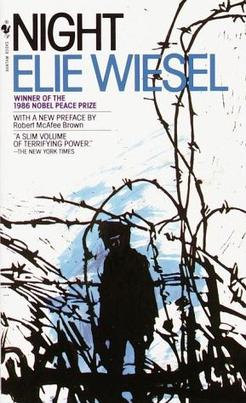
Review: Night - Elie Wiesel

*Image from papercuts.tscpl.org
Title: Night
Author: Elie Wiesel
Date Read: January 2007
Rating: 4.25/5

I'm not sure what happened between the years that I was in high school and when my sisters went, but I wasn't assigned this book. So, like usual, I took my sisters' handmedown for this one (pretty sure they probably haven't read any of those books I "borrowed").

What a powerful little book. I read Night in a few hours (although maybe stretched over two days...?). Wiesel's memoir begins in a sleepy town in Transylvania--seemingly far away from the dangers of the Nazi's. It comes to pass however, that the SS does invade the town and Wiesel's family is sent first to Auschwitz where he is separated from his mother and sisters, but sticks by his father's side. The rest of the novel recounts the horrid details of the Holocaust and Wiesel's own fight to survive. The details he
offers are sobering--it is a tough look into humanity at its worst.

While the book in many ways is important for our understanding of the things that happened, things that are too horrible for me sometimes to even comprehend (I would also recommend "The Hiding Place" by Corrie ten Boom and Primo Levi's accounts for different perspectives), don't expect to feel uplifted at the end of the novel.

"I wanted to see myself in the mirror hanging on the opposite wall. I had not seen myself since the ghetto. From the depths of the mirror, a corpse gazed back at me. The Look in his eyes, as they stared into mine, has never left me" (109).